About Narwal

AI-first IT services company serving 50+ clients, with over 500 projects delivered and a 98% satisfaction rate (4/4 NPS). We provide customized, scalable solutions across AI, Data, and Quality Engineering, enabling businesses to innovate faster and operate more efficiently.

Narwal specializes in AI, Data, and Quality Engineering, delivering innovative software solutions that enhance user experience and drive growth.

narwal-accelerators-menu

Latest Featured Resources

What-Is-Data-Modernization
Presentation-Proposal-Presentation

Architecting the Future of Your Data

We specialize in end-to-end data engineering services meticulously crafted for businesses fostering a data-first culture. From traditional ETL to cutting-edge lakehouses, we don’t just meet industry standards, we exceed them.

Building the Foundation for a Data-First Enterprise

At Narwal, Data Engineering means more than moving data from A to B. We design connected, unified platforms spanning hybrid architectures, data warehouses, lakes, and real-time pipelines so your organization can harness data at scale and drive decisions with confidence. 

The Value Proposition

Why partner with us?

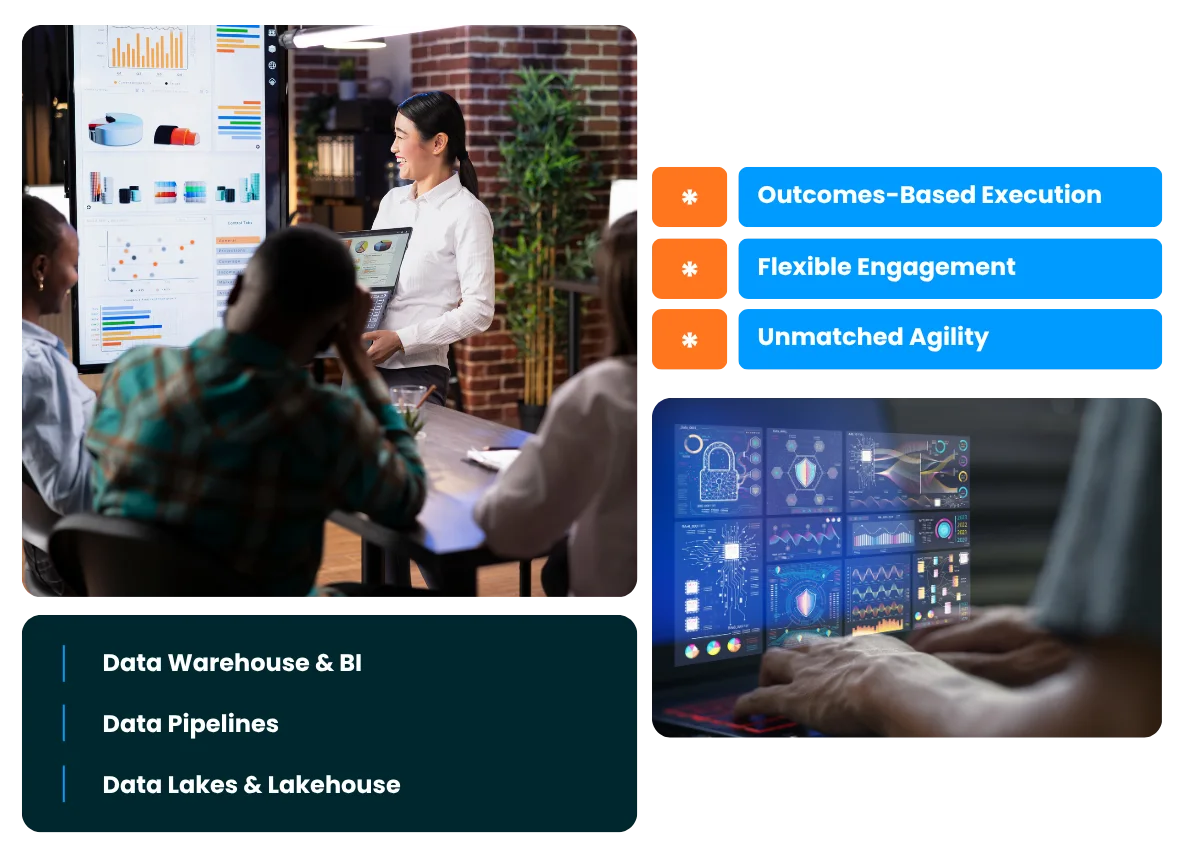
Outcomes-Based Execution

Outcomes-Based Execution

We deliver results using flexible capacity-based or factory models that guarantee execution.

Flexible Engagement

Flexible Engagement

Whether you need a scalable project-based team or a long-term strategic partnership, our models adapt to you.

Unmatched Agility

Unmatched Agility

In a world of AI, speed is currency. We provide rapid, adaptable solutions to keep pace with evolving demands.

Our Customized Approach

A strategy as unique as your data.

Grounds-Up

We start with the end in mind. By understanding your business drivers first, we design a comprehensive data-to-decision pathway.

Clinical

We cut through the noise. Our framework structures vast amounts of information into clear, prioritized requirements.

Targeted

Precision-engineered integration. We transform and model data specifically to answer your most critical business queries.

Our Core Offerings

Fueling your analytics with robust architecture.

Ready to Turn Your Data Into Your Greatest Asset?

Let’s build a scalable, AI-ready foundation together.

Technology & Industry Insights

Frequently Asked Questions

Data Modernization is the process of transforming legacy platforms into cloud-based data platforms. This evolution is essential for aligning with current and future business needs, enabling operational efficiencies, and gaining a competitive edge. By embracing a data-first culture, businesses can derive actionable insights that drive growth.

The critical components of data modernization include:

  • Modernization Strategy
  • Data Migration
  • Data Engineering
  • Intelligence & Analytics

At a high level, a data modernization strategy outlines a value map that connects data providers, business consumers, data infrastructure, and organizational goals. This strategy is followed by a detailed roadmap for implementing data programs that deliver measurable value.

The primary business drivers for data modernization include:

  • Gaining operational efficiencies and a competitive edge.
  • Managing CAPEX/OPEX and reducing total cost of ownership (TCO).
  • Creating a unified, centralized source of truth for data.
  • Designing scalable and high-performing data services and platforms.

Narwal helps clients overcome these challenges by modernizing data platforms, embracing a data-first culture, and enabling the derivation of valuable business insights.

Data Engineering involves designing and building modern, connected, unified, and trusted data platforms using hybrid architectures, data warehouses, lakes, and pipelines. It is a key process in harnessing and managing data effectively within a data-first culture, driving innovation, improving efficiency, and fostering business growth. 

A Data Pipeline is an automated system that acquires, ingests, transforms, and stores data within a data lake or warehouse. This process ensures that data is ready for analysis and decision-making.

Data pipelines can be categorized as follows:

  • Batch or Cold Data Pipelines: Process large volumes of data infrequently, often during off-peak hours.
  • Near-Real-Time or Warm Data Pipelines: Handle data with minimal delay, typically processing it within seconds or minutes.
  • Real-Time or Hot Data Pipelines: Manage continuous streams of real-time data, requiring low latency and high fault tolerance.

A typical data lake architecture follows the Medallion Design pattern, which manages data across multiple logical layers:

  • Raw Data: Source data stored as-is, often in Parquet format, supporting scalability and performance.
  • Filtered/Cleaned/Integrated Data: Sanitized and lightly transformed data, with support for change data capture.
  • Transformed/Enriched Data: Business-facing data, dimensionally modeled for visualization and ready for consumption.

These logical layers are based on business and resource requirements and may vary.

AWS provides a comprehensive suite of data services for building data lakes, including:

  • Acquisition/Ingestion Services: DMS, Lambda, Kinesis Firehose, Data Sync
  • Orchestration, Integration & Transformation Services: Glue, MWAA Airflow, EMR, AWS Batch
  • Storage (Medallion Architecture, including CDC): S3 with Iceberg + Redshift/RDS
  • Cataloging: AWS Glue Catalog/Crawler
  • Federation & Visualization: Athena, QuickSight

Data Monetization is the process of transforming data into a strategic asset that drives business value and growth. It can be approached in two ways:

  • Direct Monetization: Selling or trading data through Data-as-a-Service (DaaS) tools, embedded analytics platforms, or data sharing.
  • Indirect Monetization: Using data for process improvement, product development, sales, marketing, and other efforts that enhance profitability.

Data analytics can be categorized into three types:

  • Hindsight: Rear-view analysis enabling businesses to measure, decide, and act or align based on past data.
  • Insight: Forward-looking analysis that allows businesses to explore, discover, and innovate.
  • Foresight: Predictive analysis that enables timely business interventions, course corrections, and optimization.