





Over the last few years, artificial intelligence has moved rapidly from innovation labs into boardroom agendas. Enterprises experimented with chatbots, predictive models, and automation pilots, often driven by curiosity as much as by strategy. While many of these initiatives demonstrated promise, far fewer translated into sustained, enterprise-wide impact.
According to McKinsey, while more than 70% of organizations report experimenting with AI, fewer than 30% have successfully scaled AI initiatives across the enterprise. This gap highlights a fundamental challenge: AI adoption is no longer about access to models it is about operationalizing intelligence.
The First Wave: AI as an Experiment
Early enterprise AI initiatives were largely use-case driven. Teams focused on narrowly scoped problems such as forecasting demand, detecting anomalies, or improving customer support efficiency.
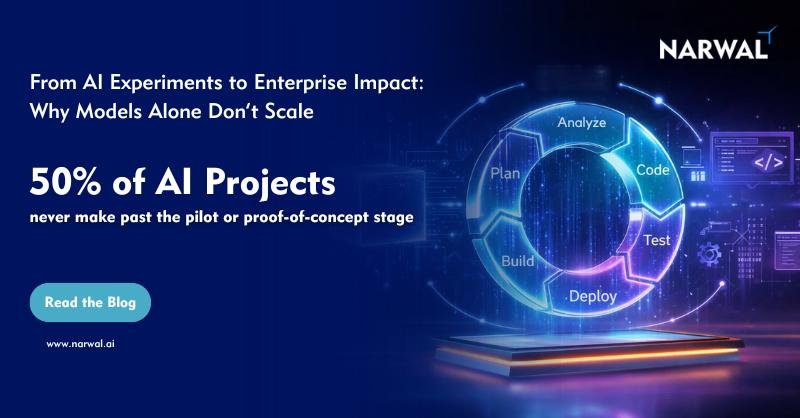
These initiatives delivered localized value but struggled to scale. Gartner reports that nearly 50% of AI projects never make it past the pilot or proof-of-concept stage, often due to poor integration with business processes, lack of governance, or unclear ownership.
Common limitations included:
- AI systems operating in isolation from core workflows
- Insights generated without clear paths to action
- Limited trust in outputs due to poor explainability
The technology was capable, but the operating model was not.
The challenge enterprises face today is not technological capability, but organizational readiness. Without rethinking workflows, ownership, and governance, even the most advanced AI models struggle to deliver durable value.
Generative AI: A Catalyst, Not a Complete Solution
The rise of generative AI marked a significant inflection point. Large language models unlocked new capabilities in reasoning, language understanding, and content generation. Enterprises quickly adopted these tools to improve productivity across functions such as marketing, development, and customer support.
According to McKinsey, generative AI alone has the potential to add $2.6–$4.4 trillion annually to the global economy, largely by augmenting knowledge work.
However, enterprises soon realized that generative AI introduces new complexities:
- Output quality varies without contextual grounding
- Governance and data security risks increase
- Standalone tools fail to deliver systemic business outcomes
This reinforced a critical insight: models create potential, but systems create impact.
From AI Models to Intelligent Enterprise Systems
Leading organizations are now shifting focus from deploying AI models to building intelligent systems embedded directly into enterprise operations.
Forrester highlights that enterprises integrating AI into end-to-end workflows are significantly more likely to realize measurable ROI, compared to those deploying AI in isolated functional silos.
Intelligent systems combine:
- Enterprise data and domain context
- Automation and orchestration layers
- Observability and Auditability layers
This evolution allows AI to move beyond decision support into decision execution driving outcomes rather than insights alone.
Why Connected Intelligence Drives Real Business Value
Disconnected AI is one of the biggest reasons enterprises struggle to scale value. When AI operates separately across functions, context is lost, handoffs increase, and decision latency grows.
Gartner notes that organizations leveraging connected intelligence across multiple business functions outperform peers on speed, quality, and operational efficiency.
Connected intelligence enables:
- Faster movement from insight to action
- Reduced rework and decision friction
- Continuous learning across the enterprise
This shift is especially critical in fast-moving environments such as software delivery, where disconnected processes often lead to delays, quality gaps, and production risks.
Governance, Trust, and the Enterprise AI Imperative
As AI systems become more autonomous, governance becomes central to scale. Trust is no longer optional.
According to Gartner, by 2026, organizations that fail to establish AI governance frameworks will see significantly lower AI adoption and higher operational risk compared to peers with embedded governance models.
Enterprise-grade AI requires:
- Transparent decision logic
- Bias monitoring and mitigation
- Secure, well-governed data foundations
- Clear accountability structures
Without trust, AI remains experimental. With trust, it becomes transformational.
What Enterprise Leaders Must Do Differently
The transition from AI experimentation to enterprise impact requires a strategic reset.
McKinsey emphasizes that AI leaders differentiate themselves by focusing less on technology adoption and more on operating model redesign. This includes aligning AI initiatives with business outcomes, redesigning workflows, and investing in talent alongside platforms.
Enterprise leaders must:
- Treat AI as a core business capability
- Prioritize system-level integration over isolated wins
- Measure success through business outcomes, not model accuracy
The question is no longer where AI can be applied, but how AI reshapes how work is done.
From Enterprise AI to AI-Driven Execution
The next phase of AI maturity is execution not experimentation.
Nowhere is this shift more visible, or more critical, than in how enterprises design, build, and operate software.
In domains like software development and delivery, intelligent systems are beginning to connect requirements, development, testing, deployment, and operations into a continuous, AI-driven lifecycle.
When intelligence flows across the SDLC:
- Decisions are made earlier
- Rework is reduced
- Quality and reliability improve before production
Forrester estimates that enterprises applying AI across the software lifecycle can reduce delivery delays and rework by 30–50%, while improving release confidence and operational predictability.
This is where AI shifts from promise to performance.
The future of AI will not be defined by larger models alone. It will be defined by:
- How deeply AI is embedded into enterprise workflows
- How responsibly it is governed
- How consistently it drives outcomes at scale
The enterprises that win will not be those experimenting the most but those operationalizing intelligence the best.
Join the Conversation
The shift from experimentation to operationalized intelligence is already underway.
In our on-demand webinar, “Accelerating the SDLC with AI: From Development to Deployment,” we show how leading enterprises are embedding AI across the software lifecycle connecting intelligence across development, testing, deployment, and operations to reduce rework and improve delivery confidence.
This session moves beyond theory and into real implementation patterns, practical architecture, and measurable business outcomes.
Move from AI experimentation to enterprise execution
Resources
- Statista – Software Development Effort Distribution
A large portion of enterprise development effort is consumed by defect resolution, rework, and unplanned changes.
- McKinsey – Shifting Quality Left in the SDLC
Improving early-stage decision quality can reduce overall rework by ~30%.
- Forrester – AI in End-to-End Software Delivery
Enterprises applying AI across SDLC decision points reduce delivery delays and improve predictability.
- Gartner – Decision-Centric AI & SDLC Performance
AI embedded into lifecycle decision points delivers higher, more sustainable ROI than isolated automation.